How to write AI prompts for blog outlines that stay on topic
A focused prompt usually works best when it includes 5 parts—topic, audience, goal, angle, and constraints—so the outline stays on topic instead of…
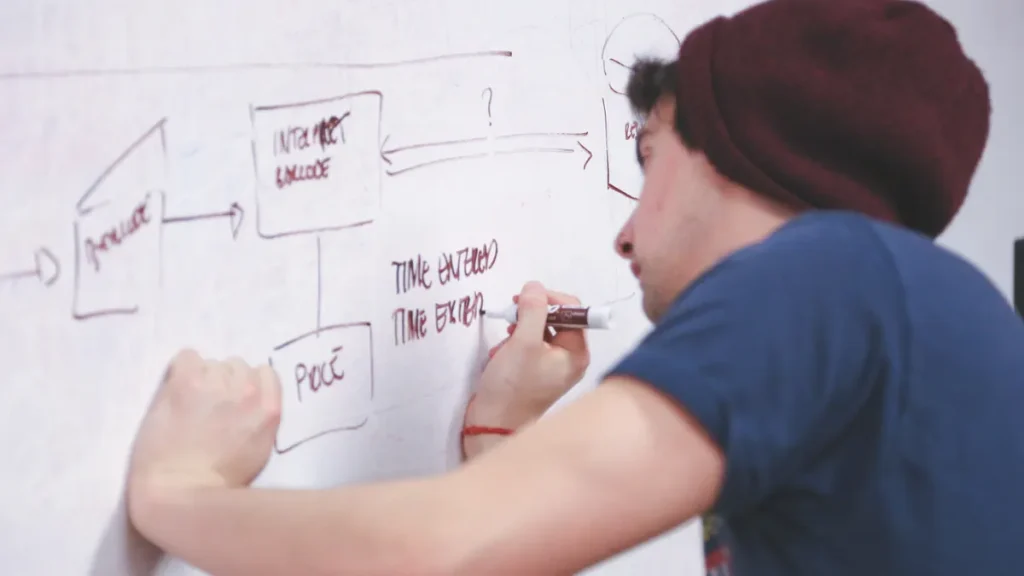
Person mapping ideas on a whiteboard
Last updated: November 05, 2026
Quick Answer: A focused prompt usually works best when it includes 5 parts—topic, audience, goal, angle, and constraints—so the outline stays on topic instead of drifting into side issues. This article explains how to write AI prompts for blog outlines that stay on topic.
A strong blog outline prompt tells the model what to cover, what to leave out, and who the outline is for. If the prompt is vague, the outline drifts into side topics, generic filler, or a structure that looks polished but misses the point. The topic of how to write AI prompts for blog outlines that stay on topic needs that kind of control from the start.
Key takeaways
- A blog outline prompt works best when it names the audience, the topic angle, and the exact outcome you want from the outline.
- The fastest way to reduce drift is usually to add boundaries: scope, exclusions, section count, and the kind of evidence or examples the draft may use.
- A good prompt does not ask for “a great outline.” It asks for a specific outline shape, with specific headings and constraints.
- Negative instructions matter because they tell the model what not to spend words on.
- The best prompts leave room for judgment, but only inside a narrow lane.
What a blog outline prompt needs to do

A blog outline prompt needs to produce a usable skeleton, not a generic list of headings. That means it has to do four jobs at once: define the blog outline, set the target audience, name the content brief, and lock in the topic angle. When those pieces are missing, the model fills the gap with broad advice and safe, bland section titles.
The simplest useful prompt has five parts:
- Topic
- Audience
- Goal
- Angle
- Constraints
If the topic is “AI prompts for blog outlines,” the prompt should not stop there. It should say whether the reader is a solo marketer, an SEO writer, or a content manager. It should say whether the outline is for a how-to post, a thought piece, or a product-led article. It should also say what shape the output should take: for example, 5 H2s, each with 2–3 H3s, no introduction headings, and no sections about tool selection.
That is the difference between “write me an outline” and “write me a blog outline prompt that stays on topic.” The first request invites drift. The second gives the model rails.
One useful habit is to treat the prompt like a mini brief. A content brief is not just a topic note; it is a filter. It should tell the model what the reader already knows, what they need next, and what the article must not wander into. That usually keeps the outline tighter than trying to fix a bad draft later. If the brief is for client work or a regulated topic, it is also worth checking the wording with a qualified professional; a source on content brief structure is Nielsen Norman Group’s guidance on content strategy and clear requirements: https://www.nngroup.com/articles/content-strategy/
Why AI outlines drift off topic
AI outlines drift because the model is trying to satisfy too many possible readers at once. If you do not narrow the brief, it will often produce headings that are technically related but practically useless. A prompt about blog outlines can easily drift into SEO theory, copywriting tips, AI tool reviews, or generic “best practices” that do not help the reader finish the article.
The main causes are predictable:
- No audience context. The model does not know if the reader is a beginner, a content strategist, or a freelancer writing under a deadline.
- No topic angle. “Write about blog outlines” is broad; “write about prompts that keep outlines on topic before drafting starts” is narrower.
- No section constraints. Without a required number of headings, the model may overbuild the outline or bury the main answer.
- No exclusions. If you do not say what to avoid, the model may add adjacent topics because they seem helpful.
- No hierarchy. The model may mix high-level framing, examples, and tactical steps in the wrong order.
A topic angle matters more than many people think. “How to write AI prompts for blog outlines” and “How to write AI prompts for blog outlines that stay on topic” are not the same task. The second one makes the core problem explicit: prevent drift before the draft stage starts. That narrow focus should shape the headings, the examples, and the limits.
A common failure is to ask for “SEO-friendly headings.” That phrase is too loose. It can produce headings that chase keywords instead of serving the reader’s actual job. If the page is about prompting for outlines, the headings should teach prompt design, not rehash SEO basics. The outline should stay inside the lane of prompt construction, not become a second article about blogging strategy. For SEO basics and search intent, Google’s own Search Central documentation is a reliable reference: https://developers.google.com/search/docs/fundamentals/creating-helpful-content
How to write the prompt in 5 steps
A good blog outline prompt usually takes about 5 minutes to write, and the extra 30 seconds you spend on constraints often saves 30 minutes of cleanup. Use this structure when you want an outline that stays focused.
- Name the exact article job. Say that you want a blog outline prompt for a how-to article, not a generic content prompt. The model should know the output is an outline that can guide drafting, not a finished article or a brainstorm list.
- Define the reader in one line. Give the audience role, skill level, and context. For example: “for a content marketer writing 800–1,200 word blog posts” or “for a freelance writer using ChatGPT to draft client articles.” That one line usually sharpens the headings.
- State the topic angle and the border. Say what the outline must focus on and what it must not cover. If the article is about staying on topic, exclude adjacent subjects like tool comparisons, prompt libraries, or brand voice systems.
- Set the outline structure. Ask for a specific number of H2s, and if needed, H3s under each one. A prompt that asks for 5 H2s and 2 H3s per H2 is easier to control than one that says “give me a detailed outline.”
- Add negative instructions. Tell the model not to use filler sections, not to repeat the same idea in different words, and not to drift into broad AI writing advice. Those guardrails cut down on generic headings fast.
A practical version might read like this:
“Write a blog outline for an article on how to write AI prompts for blog outlines that stay on topic. The reader is a freelance content writer. Focus on outline structure, angle selection, section constraints, audience context, and negative instructions. Give me 6 H2 sections, with 2–3 bullet points under each. Do not include tool comparisons, brand voice advice, or general AI writing history.”
That prompt is short, but it carries the essentials. It gives the model a topic, a reader, a scope, and a set of exclusions. It also asks for a shape, which helps the outline feel usable instead of loose.
What to include in the prompt so the outline stays focused
A focused prompt names the audience, the content brief, the topic angle, the section constraints, and the negative instructions in the same block. Leaving any one of those out gives the model room to wander.
The prompt needs enough detail to steer the output, but not so much that it becomes a paragraph of noise. A good target is 60–120 words for the instruction block. That is usually enough room for a subject line, a reader profile, a scope statement, and an explicit “do not cover” list.
Here is what to include:
- Target audience: Who will use the outline?
- Content brief: What article is the outline for?
- Topic angle: What is the exact problem being solved?
- Section constraints: How many sections, and what format?
- Negative instructions: What topics should not appear?
The audience line should be concrete. “Marketers” is too broad. “Solo content marketers writing blog posts for lead generation” is better. The more specific the audience, the better the outline headings tend to be.
The content brief should give the article purpose. For example, if the article is meant to help writers keep prompts on topic before drafting begins, the outline should focus on setup and control, not polishing the final draft. A content brief like that often reduces wasted sections because it tells the model what kind of support the article should provide. If the article is for client work or a high-stakes subject, it is safer to verify the prompt with a qualified professional before using it. A source on plain-language instructions and audience needs is GOV.UK’s style guidance: https://www.gov.uk/guidance/content-design/writing-for-gov-uk
The negative instructions are the part many writers skip. They should not be vague. “Don’t be generic” helps less than “do not include sections about choosing an AI writing tool, style guides, or writing experiments.” The second version gives the model a clearer boundary.
One useful standard is to ask for headings that match the reader’s stage of work. If the reader is still shaping the prompt, the outline should cover framing, constraints, and structure. If the prompt is already good, the outline can move toward examples and refinement. Mixing those stages in one outline often creates confusion.
Common prompt mistakes that make outlines wander
The biggest mistake is asking for an outline before deciding what the article is really about. That usually produces headings that sound reasonable but miss the main problem. If the article is about staying on topic, the outline should not spend half its space on generic AI writing advice.
Another mistake is writing prompts that are too open-ended. “Create a detailed outline for a blog post about AI prompts” sounds flexible, but it usually invites drift. The model may cover prompt engineering, AI tools, content marketing, and SEO in the same structure. That kind of outline often looks complete and still fails the brief.
A third mistake is loading the prompt with buzzwords instead of instructions. Words like “optimized,” “engaging,” or “high-quality” do not tell the model what to do. A better prompt names the parts: 6 sections, no tool review, focus on prompt boundaries, include examples of negative instructions. Concrete direction beats praise.
A fourth mistake is forgetting the level of the reader. If the audience is a beginner, a prompt that asks for advanced framing will feel too abstract. If the audience already knows the basics, a prompt that asks for a “what is AI?” section wastes space. The outline should match the reader’s current problem, not the writer’s favorite explanation.
The cost of these mistakes is not just a messy outline. It is draft time. A weak outline can send a writer into a 1,000-word detour before the real point appears. Fixing that later is slower than narrowing the prompt at the start.
The fix is simple but disciplined: say the job, set the scope, define the reader, and ban the off-topic routes. If a section would fit in a different article, it probably does not belong in this one.
A prompt template for blog outlines that stay on topic
A reliable template is: topic + audience + angle + structure + exclusions + output rules. That formula works because it gives the model a narrow target and enough room to build within it.
Use this template:
“Create an outline for a blog post about [topic]. The reader is [audience]. The article should focus on [topic angle]. Include [number] H2 sections and, if useful, [number] H3s under each. The outline must cover [required subtopics] and exclude [forbidden subtopics]. Keep the structure practical and specific. Do not add generic filler sections.”
If you want the outline to support drafting, add one more line:
“For each heading, include a short note on what the section should accomplish.”
That extra line often improves the result because it forces the model to explain the purpose of each section, not just name it. A heading like “Set the scope before drafting” is more useful when the prompt also tells the model that the section should explain audience context, angle selection, and constraints.
A strong template for this topic might look like this:
“Create an outline for a how-to article on writing AI prompts for blog outlines that stay on topic. The reader is a freelance writer or content marketer. Focus on outline structure, angle selection, section constraints, audience context, and negative instructions. Use 6 H2s, with 2 H3s under each H2. Exclude tool comparisons, brand voice systems, and general AI writing tips. Make the outline practical and specific.”
That prompt is not long, and that is the point. Short prompts can still be precise when each sentence earns its place. If you need to make it stricter, add a sentence about what the reader should be able to do after reading the article. That helps the model aim the outline at action instead of description.
For more prompt-building patterns, an AI prompt library can be a useful next stop, but the same rule applies there: a good prompt narrows the job before the drafting begins.
Should you include SEO terms in outline prompts?
Yes, but only when the terms serve the outline instead of steering it off course. SEO terms can help the model understand the article’s search focus, yet too many keywords can pull the outline away from the actual reader problem.
A good rule is to include one primary phrase and a few natural related terms. For this topic, that might mean “AI prompts for blog outlines,” plus related phrases like “blog outline,” “target audience,” “content brief,” “topic angle,” and “negative instructions.” Those terms are useful because they reflect the article’s structure, not just its search visibility.
What should not happen is keyword stuffing inside the prompt. If you repeat the same phrase five times, the model may echo it in the outline and turn the headings stiff. A prompt should sound like a direct instruction, not a keyword list. One clean mention of the topic is usually enough.
SEO terms are also most useful when they align with the outline’s logic. If a keyword names a concept that the reader needs to understand, include it. If a keyword only exists to chase search traffic, leave it out of the prompt and handle it later in the draft. The outline should be shaped by the reader’s task first.
That trade-off matters. A prompt that tries to satisfy too many search phrases often produces headings that are safe but flat. A narrower prompt can rank well and still read like it was written for humans, not a spreadsheet. For search intent and keyword placement, Ahrefs’ overview of on-page SEO is a practical reference: https://ahrefs.com/blog/on-page-seo/
What makes a good blog outline prompt?
A good blog outline prompt gives the model a clear job, a narrow audience, and firm boundaries. It should say what the article is about, what angle matters, how many sections to build, and what not to include. Good prompts sound like a short brief, not a vague request for “something detailed.”
How do you keep an ai outline focused?
You keep an ai outline focused by adding constraints before the model starts writing headings.
Drafted with AI; not yet reviewed by a person.